The U.S. Under-20 Men’s National Team that took on England, Japan, Cameroon and Spain at the 1999 FIFA World Youth Championship in Nigeria was loaded.
Five players went on to represent the USA at FIFA World Cups: Chris Albright, Carlos Bocanegra, Tim Howard, Steve Cherundolo, and Nick Rimando, while Cory Gibbs was originally named to the 2006 FIFA World Cup squad before suffering an injury. It also included guys who would have solid pro careers, like Danny Califf, Nick Garcia, Rusty Pierce, John Thorrington and Taylor Twellman.
Fast-forward 20 years, and three players from that team are still active: goalkeepers Howard and Rimando – who have announced they will retire this year – and….midfielder Ryan Futagaki.
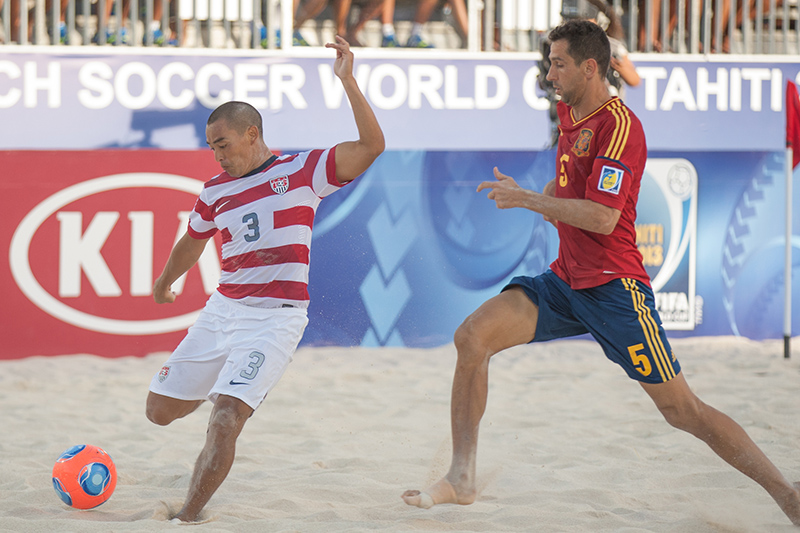
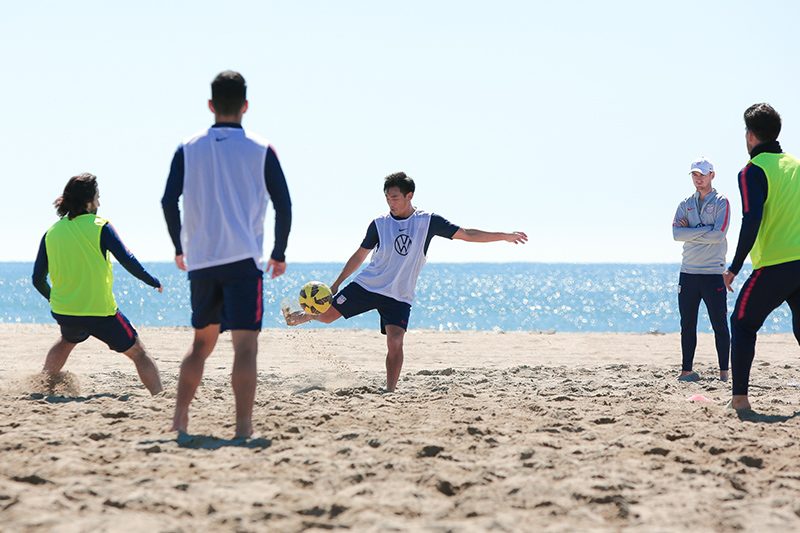
With little fanfare, ‘Futo’, as he’s affectionately known, actually became the sixth player from that team to represent the USA at a senior FIFA World Cup. If you haven’t been following, the 39-year-old is now a veteran of six U.S. Beach Soccer National Team cycles. He became the first American to have scored in a FIFA U-20 World Cup and a FIFA Beach Soccer World Cup in 2013 when he registered the USA’s first goal on sand against Spain in Tahiti.
And he’s not done wearing the crest.
It’s a pretty remarkable feat for someone who nearly quit soccer when life handed his family more heartache while he was at UCLA.
==========
Ryan was your typical Southern California kid. Growing up in Huntington Beach, he enjoyed the sun, sand, surfing, skateboarding and soccer.
But as fourth-generation Japanese-American, he was also aware of their family’s suffered past. By the 1940s both sets of grandparents had been well established in Southern California. Born in the States and with a proud Japanese heritage, they owned farms and other property in between Los Angeles and San Diego. But their lives changed in a blink of an eye by an unimaginable act.
There are other sites where one can read about the Japanese internment camps that were established during World War II. In short, the U.S. government ordered that Japanese descendants be relocated to isolated detention camps. Ryan’s grandparents were moved to one in a remote area in Arizona.
Theirs is a story of perseverance, and that is a value that has been at the forefront of Ryan’s life and career.
“I come from a very strong family,” Futagaki told ussoccer.com. “Life is about overcoming things. My dad and mom instilled that in me – you work your ass off, you put the effort in, you never quit and you will succeed.”
A small-framed Ryan had progressed onto the Youth National Team scene. And after not making the 1997 FIFA U-17 World Cup team, he caught the attention of the late Sigi Schmid, who brought the 5-7 midfielder to his UCLA squad.
“Sigi was one of my biggest mentors,” Futagaki said. “He not only built me as a soccer player but also as a person. He taught me a lot and really took me under his wings.”
Sigi was then coaching the U-20 MNT and included Ryan on the roster for the 1999 FIFA World Youth Championship in Nigeria.
“That was a very special team,” Ryan recalled, fondly. “Everyone knew their roles and we had great leaders. Steve Cherundolo was an absolute rock, a leader on and off the field and the best professional I’ve ever known.”
After defeating England in the opener, Futagaki’s personal highlight came in the team’s second group match when he scored the USA’s lone goal in a 3-1 loss to Japan.
The team got out of the group stage and gave eventual winners Spain a run for their money in the Round of 16 before falling, 3-2.
He was also called up by another U.S. Soccer coach legend, the late Clive Charles, for the U-23 team at the Pan American Games, helping the USA claim the bronze medal.
“I loved every bit of it,” he added. “That pride in wearing the crest. When I put it on and crossed that line, it was everything.”
His success was perhaps more uplifting to his family than even for himself. Years earlier his father, Arnie – Ryan’s biggest fan – had been diagnosed with ALS.
And with his father’s condition worsening, the family was hit with the news that his mother, Shirley, had Stage 4 breast cancer.
“I contemplated quitting when mom was diagnosed,” he said, a sophomore at the time. “But my dad made me promise that I would graduate.”
Arnie passed the summer before Ryan’s final year at UCLA. He dedicated that season to his dad, and fittingly assisted in the 2002 NCAA College Cup final as UCLA capture their last men’s soccer title to date.
His mom also miraculously won. Even after open heart surgery last year, she’s still clear and healthy in 2019.
Ryan was drafted by the Chicago Fire in the later rounds of the 2003 MLS SuperDraft. He made the team and was part of the U.S. Open Cup winning side that also were MLS Cup runners up that year.
When Futagaki was waived during the following preseason, he turned to Schmid for advice.
“He told me, ‘You got to live your dream of becoming a pro, go back to college and finish,” Ryan said of his mentor’s honesty.
Ryan had missed two semesters while with the YNT, so after a year trying the indoor game, he returned to fulfill the promise he made to his dad. He graduated from UCLA in 2007 as a history major, though he would soon start a successful career in bio-tech pharmaceutical sales.
His soccer days were over.