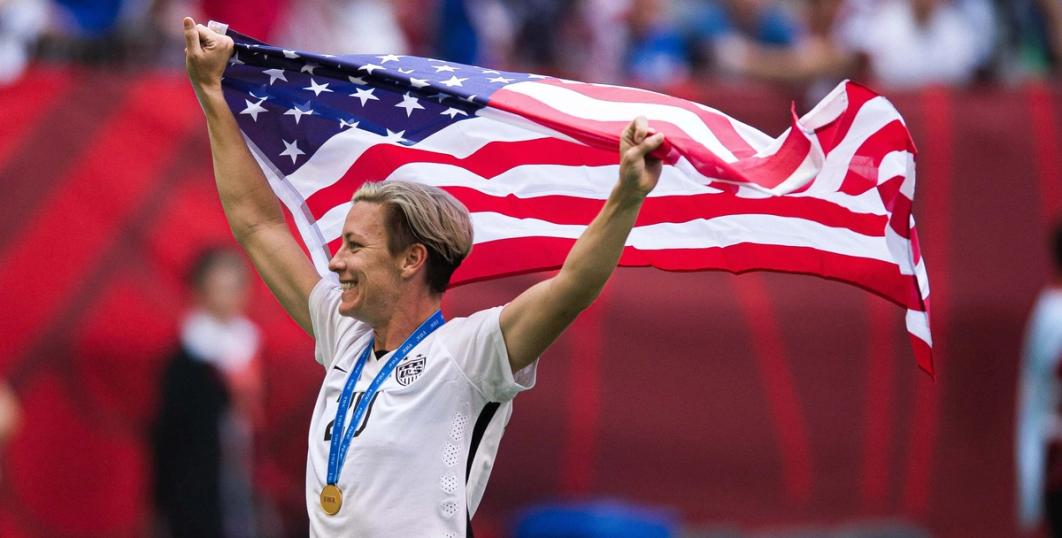
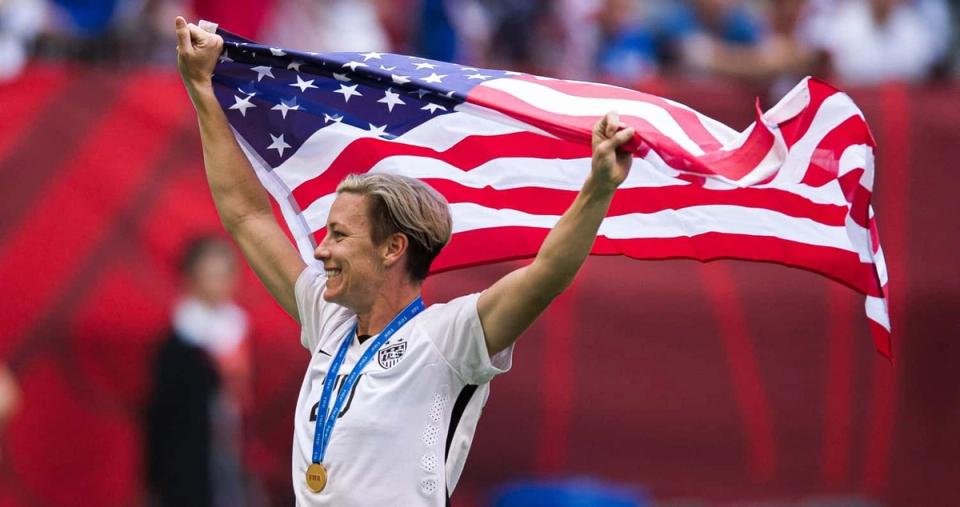
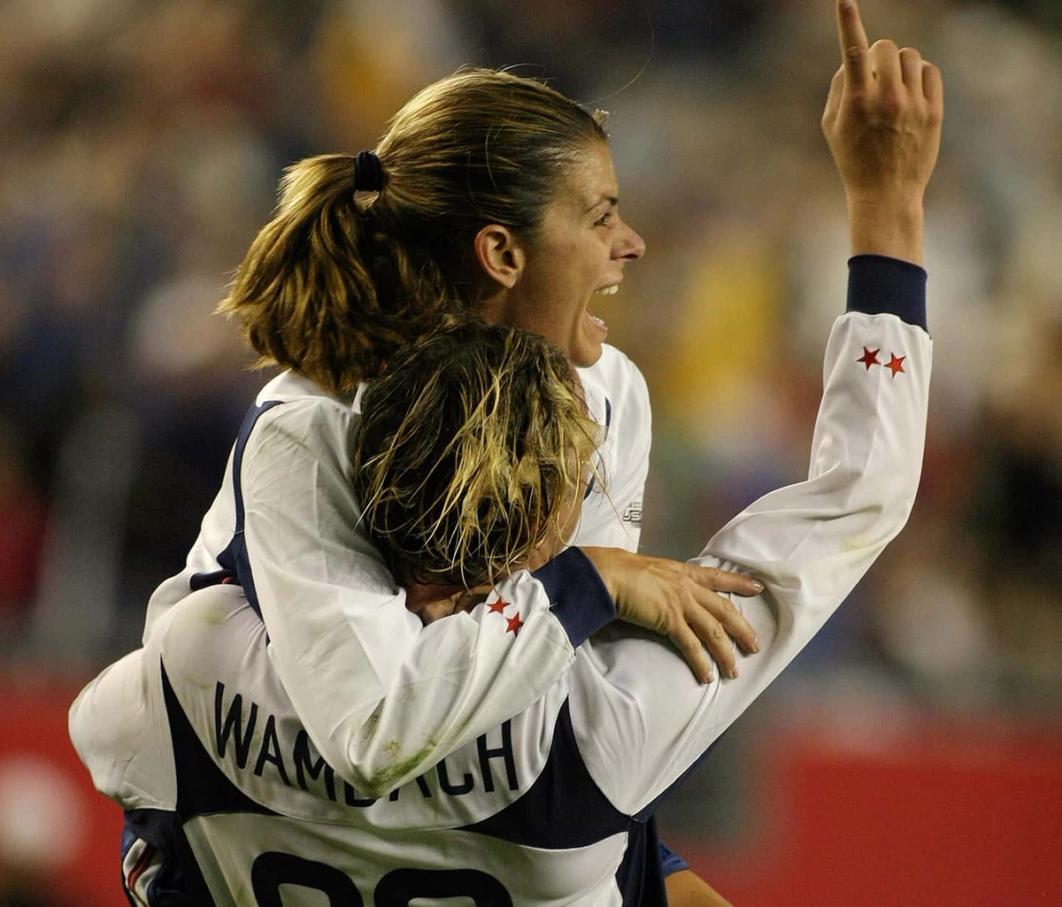
No one, man or woman, has scored more international goals than Abby Wambach. She’s a legend by any measure. It’s curious then, that on the eve of her inevitable induction in the National Soccer Hall of Fame, she chose first to consider the doubts that plagued her early in her career. “I was terrified because I was the by far the worst player there,” said Wambach, ever humble and searching for answers, about her first call-up to the U.S. Women’s National Team back in 2001. “They all played in fast forward, and I was like a turtle trying to catch up and always falling behind and not knowing what was going on.”
Born in a Pittsford, a small town in upstate New York near Rochester, Wambach was the youngest of seven children in a sports-crazy family. Her earliest memories are of being carted from one sporting event to another on mom or dad’s hip, watching her siblings perform on basketball and volleyball courts. Soccer fields too. On the surface, her slide into the game was in no way noteworthy – the usual route through local rec leagues. “But when you’re a kid in a big family, it’s part of your job to figure out how the whole system runs and your part in it,” said Wambach, who found an identity early in the game. “Soccer helped me do that. It helped me get noticed and give me a sense of worthiness.”
‘How to Play Soccer’ – by the Book
The Wambachs weren’t stepped in soccer culture or know-how. When Abby’s oldest sister Beth wanted to play the game, mom and dad went to the public library and checked out, “’How to Play Soccer’, I think the book was called,” laughed Wambach, once a Women’s World Cup winner and twice an Olympic gold medalist. “That’s really how the game came into our family.”
She took to soccer straight away. And it wasn’t just that young Abby was fearless (she was, and remained so throughout a near two-decade career in college, pro and the National Team). Her acumen for scoring goals was obvious, and ominous, from the start. She bagged 27 in her first three games in youth soccer. “I knew this thing [soccer] would serve me in multiple ways. It was active and positive and it helped with self confidence.”
Wambach excelled at the Olympic Development (ODP), State and Regional levels – mainly due to her ability to find the back of the net. Her first call into a National Team camp came when she was 15 in 1996 when she was already showing glimpses of the aerial ability and physicality that would make her virtually unplayable later in life. But, again, there were doubts. “I remember it really well, the feeling unworthy and like I didn’t belong. All these other 15-year-olds were so much better than me,” said Wambach, who was called in over and over up the youth chain through U-16 to U-21 camps. “But I knew I had more potential than I was showing. I was really raw back then. I didn’t like to train. I liked to play games and score goals, but there was still something missing.”
The underlying goal for a young Wambach was securing a full scholarship to play in college. That was the springboard. “It brought a sense of autonomy – like I’m down here on Planet Earth and I have control of my life. It was essential for my growth as a person, but I didn’t really have any aspirations,” admitted Wambach who still had doubts despite being a high school all-star and a NCAA national champion in her freshman year at the University of Florida where she won four-straight Southeastern Conference titles and scored 96 goals with 50 assists in 93 matches. “Of course I dreamed of being on the National Team, but there was nothing inside me that said I could, and I wasn’t confident that I could. I was a million miles from [Kristine] Lilly and Mia [Hamm] and Michelle Akers – to even watch those women play felt like an accomplishment. I didn’t understand playing with them was possible.”
On the Cusp of Greatness
Not only was it possible, it was closer than she knew. After one U-21 National Team Camp, coach Jerry Smith [husband of Brandi Chastain and head coach at California collegiate power Santa Clara] called Abby in for the usual post-camp assessment. “He told me, basically, that my physical fitness is holding me back,” Wambach remembered. “But he also told me I had everything else I needed and, if I could make some changes, I could be in that impossible place of the National Team. It was one of those oh-wow moments. He reached me and pushed me beyond my fears and feelings of unworthiness.”
Inside three months Wambach was called to the full National Team for the first time. She was 21 and thrown in beside those legends she’d only considered on TV screens. World beaters and heroes of the transformational 1999 World Cup like Kristine Lilly, Brandi Chastain, Julie Foudy and Mia Hamm. “It was basically like an out-of-body experience. I was asking myself, ‘is this real life?’” Wambach said. “It was that really important time that people don’t really talk about. It’s a character test. How will you handle it? Here I am again not feeling worthy. I told myself ‘play my game. Remember what I’m good at. I can’t be someone else. I knew I could score goals, so I focused on that.”
It wasn’t an easy transition for Wambach, from preternatural goal-scorer to conscientious athlete, doing the little things to become the best she could be. “It’s a lifestyle change and I had to surrender to the process of becoming a serious athlete and a competitor,” she said of those early days in the cauldron of the National Team. “But nothing you did before the National Team matters – not your high school medals or your college goals. In the National Team you have to bring one thing that no one else can.”
Mia Hamm’s Impact
Wambach’s graduation from an astonishing collegiate career and her first taste of the full National Team coincided with the forging of a major relationship in her soccer life (and life in general). She was drafted second into the now defunct Women’s United Soccer Association (WUSA) by Washington Freedom – a disappointment for such a competitor. “But I got over the disappointment really fast because I saw that I would be playing with Mia Hamm,” Wambach said, still thrilled by the pivotal moment all these years later. “I made it part of my plan to take every opportunity to soak up everything I could from her. I told her all the time ‘Mia, you’re the best so tell me everything you know’.”